
Persistence Tastes Like Dates
And other things that grow in deserts.

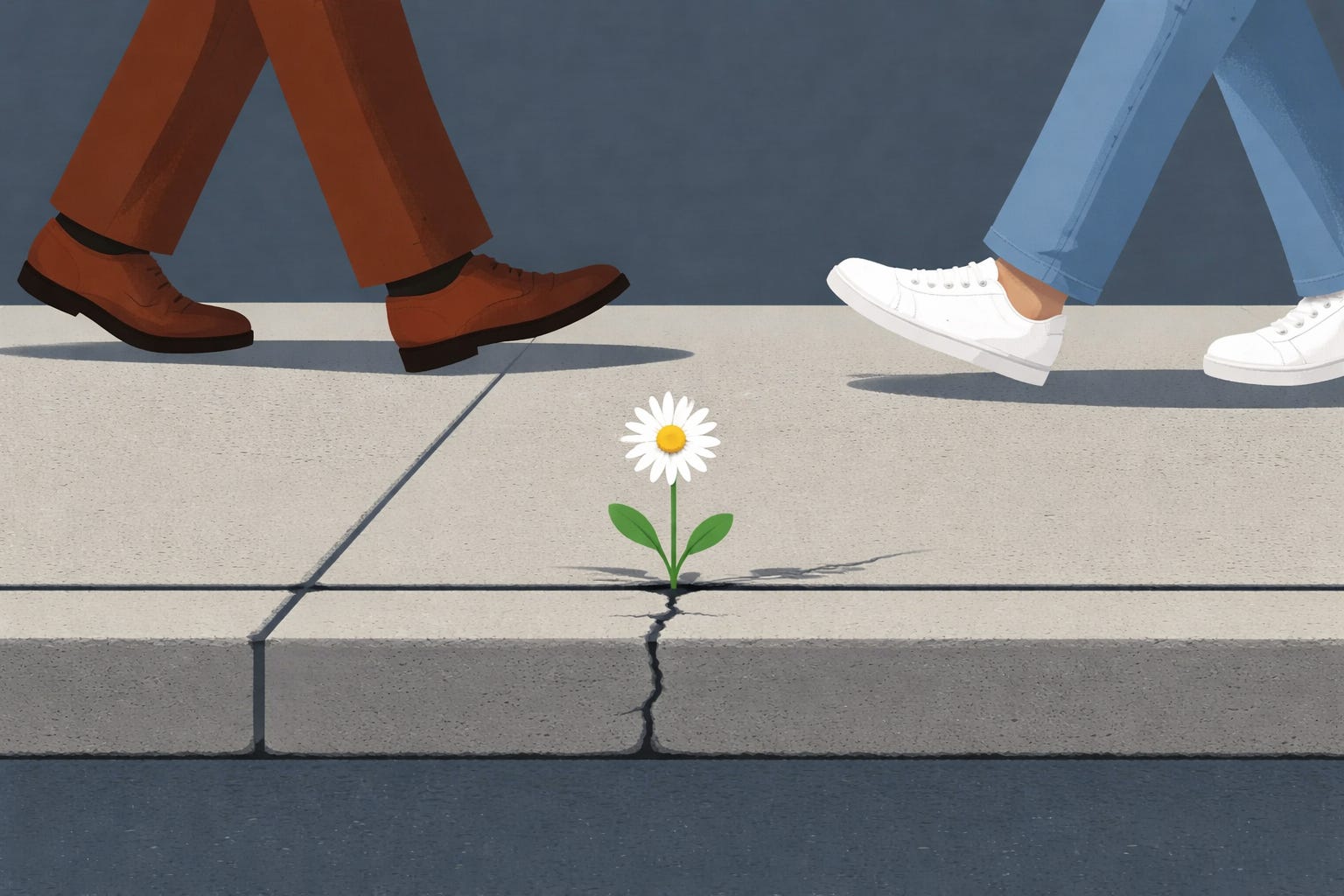
In 2009, I had an idea for a story while I was in Baghdad. I already had a name for it: The Widow of Baghdad. I wanted to use the abrupt tragedy of love lost to capture a city frozen by war, all its plans and construction projects, dashed. I just needed a widow.
I met Samira in the lobby of a hotel in Baghdad, over club sandwiches without ham. She arrived dressed like a panther who had eaten a canary. Animal print. Dyed honey-blond hair. Not a trace of mourning in sight. She was also, persistently, the only woman still working at Baghdad International Airport. I had constructed someone else entirely in my mind. Someone softer. More defeated.
She told me about her husband. A university professor. She had been the girl in the canary yellow dress in the front row. They married. He was tall, lean, outspoken. He left work alone one evening and never made it home. An assassin described him vaguely afterward in a record I found in a police station. Tall, academic, critical of Saddam’s regime. A routine elimination.
She told me she would never remarry. Never love again.
Then she told me about her colleague Faizeh, who used to drive her to work and stop for coffee. Once, at a gas station, a man told her to cover her hair. Faizeh replied: “Every day this country is a new country. A country is what we make of it.” The man dragged her from the car and shot her dead in front of Samira.
Three days later, Samira went back to work alone.
I had come looking for a metaphor about grief and got something else entirely. I got a woman who had absorbed every reason to stop, and simply had not.
On my way back through the hotel I passed a makeshift food stand between the perimeter wall and the hotel entrance. A man in his forties and his son, maybe ten, served hummus, foul, taameya, and sometimes fish. I sat down to type up Samira’s story. I looked up just in time to see the father hold out a glass of water to his son. The boy carried it to the corner, where a single tree grew in a plastic pot. A date palm. He poured the water around its base. Water was precious. They had refused me extra when I asked. But every evening, without fail, they watered that tree.
I think about persistence differently than I used to.
I used to think it meant not giving up. Enduring. A kind of grim, teeth-clenched refusal to be counted out. The popular imagination tends to romanticise it this way: the lone individual holding on through sheer force of will. But the research tells a more interesting story.
Psychologist Angela Duckworth, whose work on what she calls “grit” has become foundational in education and performance science, defines persistence not as stubbornness but as the sustained combination of passion and long-term effort toward a goal. In studies spanning West Point cadets, National Spelling Bee competitors, and inner-city schoolchildren, she found consistently that grit predicted achievement better than IQ, talent, or socioeconomic background. The cadets most likely to complete the notoriously gruelling first summer were not the strongest or the smartest. They were the ones who kept going.
What her research also shows, and what tends to get less attention, is that persistence is not a fixed trait. It is built. It is practised. It is, in the language of Carol Dweck’s parallel work on growth mindset at Stanford, a skill that develops through repeated engagement with difficulty, not avoidance of it. You do not arrive at persistence. You accumulate it.
Political scientist Erica Chenoweth’s research on civil resistance adds a structural dimension to this. Analysing hundreds of political campaigns over more than a century, she found that nonviolent movements that sustained active participation from at least 3.5 percent of a population have never failed to achieve their goals. Never. The number is surprisingly small. But the word sustained is doing a great deal of work in that sentence. The movements that failed were often not lacking in passion or numbers at their peak. They were lacking in persistence.
And it requires a particular kind of faith. Not religious faith, necessarily, though that sustains many people. A structural faith: the belief that what you are building now will matter later, even if you cannot see how.
I have been covering the Iran conflict for AFP since the beginning, watching the machinery of war inch slowly towards the machinery of diplomacy. The talks are now in Islamabad. Every headline is about enrichment percentages, missile programmes, and who controls the Strait. And the Iranian people, who have been resisting the IRGC for more than forty years, who took to the streets in the largest protests since the 1979 revolution, who kept going when the internet was cut and the military deployed and thousands were killed and tens of thousands arrested, are still being left outside the room.
This is not new. People have always been left outside the room. What is also not new is what happens when they refuse to accept that as the final answer.
In 1998, two women from the Northern Ireland Women’s Coalition forced their way into the Good Friday Agreement negotiations. No party apparatus. Almost no resources. They were told, plainly, that they did not belong there. They showed up anyway. They stayed at the table until civilian inclusion was part of the language of the agreement.
There were Cambodian documentation networks whose evidence shaped the Paris Peace Accords. Bosnian civil society organisations pushed civilian protection clauses into the Dayton Agreement. Files full of violations committed in Yugoslavia were dismissed as irrelevant to peace talks, until they became the foundation of war crimes indictments that rewrote an entire post-war political order.
None of this happened because the world suddenly decided to care. It happened because people kept building the case after the cameras moved on.
Persistence is one of the twenty virtues at the centre of the character education work I do alongside my journalism. And I will be honest: it is not the most poetic one. It does not shimmer the way curiosity does. It does not carry the moral weight of courage or the warmth of empathy. It is quiet and unglamorous.
It is also, the evidence suggests, among the most consequential. A 2019 meta-analysis published in Psychological Bulletin, reviewing more than 80 studies on perseverance and academic achievement, found it to be one of the strongest predictors of long-term outcomes across cultures and contexts. Not intelligence. Not resources. The willingness to keep going.
Which presents an uncomfortable implication. If persistence is buildable, teachable, and this powerful, then the question of who gets to develop it, and under what conditions, matters enormously. Research consistently shows that persistence is harder to sustain under chronic stress, trauma, and instability. The same conditions, in other words, that conflict and authoritarianism systematically produce. The IRGC has not only imprisoned and killed. It has spent forty years manufacturing the precise conditions that erode the capacity to persist.
That is not incidental. That is the strategy.
If we want the Iranian people to have a seat at the table in Islamabad, the path is not outrage. Outrage has a short shelf life. Research on what is sometimes called “compassion fatigue” shows that emotional responses to crisis peak early and decay quickly, particularly in media audiences exposed to repeated coverage of the same conflict. Outrage peaks and falls and exhausts the people who carry it. The path is meticulous, organised, specific, sustained pressure. It is benchmarking sanctions relief to human rights conditions. It is coalition-building with Ukrainians and Syrians and every community that knows what it means to be erased from negotiations about their own future. It is documentation. Names, dates, locations, testimonies. Memory that becomes leverage because it is ready.
It is not the dramatic work. It is not the work that gets covered.
On my last day, I was stranded at Baghdad International Airport for eighteen hours. A sandstorm had grounded every plane. I sat on the ground with other passengers, with no expectation of comfort or schedule.
Samira was working. She moved through the terminal like someone who had decided, a long time ago, that this place was hers to look after. She saw me, caught my eye, and gave a small lift of her chin. A precise gesture. It said: you will be fine.
When it was finally time to board, she took our seat slips at the gate. As I passed, she stopped me. From her pocket she produced something small and placed it in my palm.
“This is all I have on me,” she said. “I grow them in my yard. They won’t serve anything to eat on the flight.”
Two plump dates.
I have thought about that gesture many times since. A woman tending a garden. Producing something from it. Pressing it into the hand of a stranger before sending her out into a storm.
I think that is what persistence tastes like.
There is something special about dates which Piet Hein celebrates in one of his pithy poems (he called them “grooks” for some reason):
DATES
A box of dates
embodies a malicious sense of fun. You eat enough,
you eat some more,
you eat until you’re done.
And then you go
and wash your hands
and take another one.
I think Samira gave you exactly the right kind of nourishment. Dates are special.